
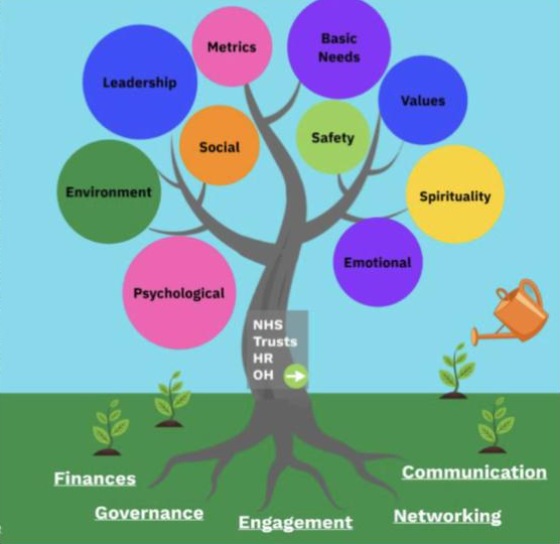



Dr Gayathri Subramanian and Dr Isabelle Butcher. The interactive online tree makes an easy to navigate toolkit taking you directly to real life case studies of wellbeing improvements operating in paediatric intensive care units in the UK.
What does it take to create a healthier working environment for staff caring for critically ill children?
Dr Gayathri Subramanian and Dr Isabelle Butcher are the winners of the 2026 Innovation Award for Mental Health for their development of the Paediatric Critical Care Well-being Toolkit. They spoke to Doctors in Distress about why they developed it, what they learned from research, and their approach.
The toolkit
Wellbeing can be an elusive concept. Healthcare organisations may have an array of initiatives, policies and support services, yet staff can still struggle to find a break, access help when they need it, or feel psychologically safe enough to say that they are struggling.
The Paediatric Critical Care Wellbeing Toolkit was developed in response to that challenge. It aims to make wellbeing practical and accessible: something that individuals, teams, managers and organisations can actively work towards rather than a vague aspiration.
At its heart is an online, interactive, easy to navigate wellbeing tree. The tree brings together different aspects of wellbeing while recognising that they depend on strong foundations. Its roots represent the organisational structures and support needed to sustain wellbeing; its branches represent different domains of wellbeing.
Evidence
The toolkit followed research which examined wellbeing of paediatric critical care nurses, doctors and allied health professionals across units around the UK (read the full text article in BMJ Open). Staff talked about issues such as access to breaks, adequate staffing and skill mix, annual leave, leadership, psychological safety, debriefing and teamwork.
The issues were not confined to one hospital. The same broad themes were being repeated across units, providing the impetus for something that could bring together evidence, experience and practical examples to improve the situation.
Q&A with the authors
What prompted you to develop the toolkit?
Gayathri: The starting point was a question from a colleague when I was working as Associate Medical Director for Workforce and Medical Education: what are you going to do to help and support our wellbeing?
There were lots of resources, but it was difficult to bring them together. It was also difficult to identify meaningful measures that could help senior leaders engage with wellbeing. We were very conscious that wellbeing should not become tokenism.
My own experiences also influenced the work. A life-changing diagnosis made me reflect on the importance of wellbeing personally, and the project became a journey of thinking about how we could do things differently. Meeting Isabelle and beginning the work together was another important part of bringing the idea to life.
It is also important to say that we don’t see the toolkit as a finished product. We want to listen to feedback, hear more voices and continue developing it.
What did your research tell you about what staff actually need?
Isabelle: I carried out research looking at the wellbeing of paediatric critical care nurses, doctors and allied health professionals across units around the country. Some of the strongest themes were very basic: being able to take breaks, having the right skill mix on the unit, being able to take annual leave, having appropriate leadership and feeling psychologically safe during debriefs.
Teamwork was also a major theme. One of the positive things about paediatric critical care is that people can feel part of a wider team, so maintaining good teamwork is really important.
What struck me was that, across the studies involving more than 100 staff from different backgrounds, people weren’t asking primarily for more money. They wanted to feel appreciated and safe at work, and to be able to do basic things such as go to the toilet or have a drink.
Those needs can be difficult to meet in an environment where staff are caring for critically ill children and staffing levels don’t always allow people to step away.
Is the problem a lack of wellbeing resources?
Gayathri: Not necessarily. People may not know what exists, may not know how to access it, or may not be able to access it when they actually need it.
We also need to be more proactive. Rather than waiting until someone is struggling significantly, organisations need to think about how they can support wellbeing earlier and more effectively.
There are also very simple things that matter: having somewhere to rest, access to water, and knowing how to access things such as freedom to speak up. These are organisational responsibilities rather than things an individual should simply have to cope with.
Why did you choose a tree as the central image?
Gayathri: Wellbeing is holistic. It isn’t just mental health, and the tree helped us make that visible.
The foundations and roots are particularly important. Organisations need the right structures, governance and leadership support for wellbeing initiatives to survive. The tree is also deliberately flexible: people’s wellbeing needs change over time, and new branches may need to be added in the future.
The little saplings and the watering can represent something else that is important to us: normalising wellbeing conversations so that they grow and spread.
We also wanted to be ambitious. The blue sky above the tree is a reminder that we should have an open mind about what wellbeing could look like and not limit ourselves to what already exists.
How is the toolkit intended to be used?
Gayathri: The toolkit contains examples from paediatric critical care units around the UK. Teams were invited to share what they were doing, what had worked, what had not worked and what they had learned.
The intention is for this to become a shared learning resource rather than a static document. A manager can use it with a team to identify priorities. Senior leaders can use it to think about wellbeing at hospital or trust level.
There is a written component, the visual tree and an aspiration checklist. The checklist isn’t intended to be an audit or a way of putting organisations on a leaderboard. The purpose is to help people make decisions: what do we need to change, and where should we focus our effort?
How does this affect leadership?
Isabelle: The roots of the wellbeing tree represent organisational responsibility. A wellbeing initiative cannot simply be added to an already pressured clinical environment without the necessary support.
Initiatives require senior leadership backing, both financially and operationally. If staff are encouraged to attend debriefs or wellbeing activities, there must also be sufficient staffing and organisational support to make that possible.
That is why the toolkit deliberately connects wellbeing with governance, leadership and organisational structures rather than treating it as an optional extra.
Does the kit recognise moral injury?
Gayathri: Paediatric critical care brings particular challenges. Staff may face situations in which they believe that what is clinically possible is not necessarily what is in a child’s best interests, or where family wishes, professional responsibilities and personal values come into conflict. Moral and ethical dilemmas are an increasingly important source of distress for staff. The toolkit therefore includes examples of approaches that help teams discuss and process these experiences.
One example is the SPICED approach at Southampton, where teams discuss ethical and moral dilemmas together. Other examples recognise that staff may have their own religious or personal values and may sometimes need sensitive support when these conflict with clinical circumstances.
Besides going and visiting the tree and seeing the case studies and work, what message would you like people to take away?
Isabelle: We want to help shift the conversation away from asking simply “How can individuals become more resilient?”. We’d like people to take away the broader question: “What kind of environment do we need to create so that people can thrive?”
The toolkit is for any person in any role in paediatric critical care. Access to the toolkit is free to all. If you want to reach the team to contribute feedback or examples of practice, you are welcome to get in touch by emailing contact@doctors-in-distress.org.uk, and we will pass your message on to the team.