
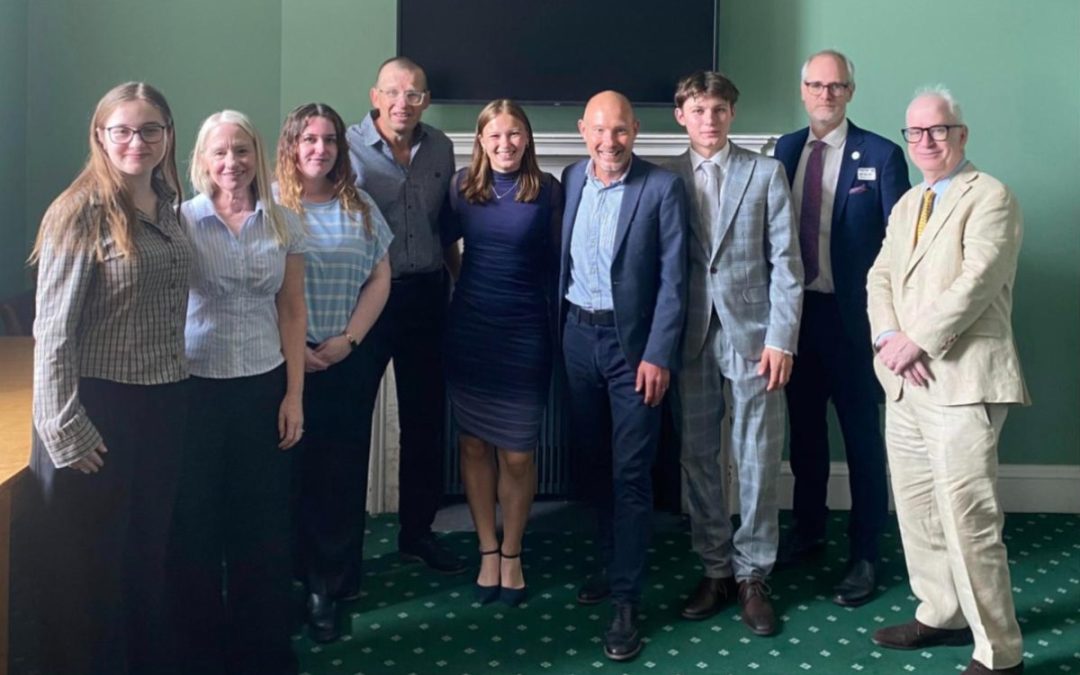
In October, Doctors in Distress presented its first Lifetime Achievement Award to the family of Professor Nicola Fear who sadly died in February of this year. With this award, we remember a pioneering researcher whose work transformed understanding of military mental health and whose compassion, generosity and commitment to suicide prevention left a lasting mark on our charity.
When Professor Nicola Fear CBE died in February 2026, aged 56, the research community lost an influential voice in military mental health. Through her work, she helped challenge misconceptions, influence government policy and improve understanding of the support needed by serving personnel, veterans and, importantly, their families.
For Doctors in Distress, an important part of Nicola’s legacy is her work helping us understand the particular pressures faced by medical professionals working within military environments.
Nicola trained as an epidemiologist and joined the King’s Centre for Military Health Research (KCMHR) in 2004, later becoming its director alongside Professor Sir Simon Wessely. Her research explored how military service, deployment and exposure to conflict affect mental and physical health, both during service and long afterwards. She became one of the principal investigators of the KCMHR military cohort study, creating an evidence base that has shaped understanding of the mental health consequences of military service.
One of the most important aspects of her work for doctors and other medical personnel was recognising that those who provide care in conflict are themselves exposed to a distinctive set of pressures. In a 2008 study, Nicola Fear and colleagues examined the mental health of UK military medical personnel deployed during the Iraq war, including doctors, nurses and medical support staff. The study found an excess of psychological distress and multiple physical symptoms among medics compared with other military personnel, as well as increased fatigue among male medics.
The findings point towards what makes working as a doctor in a military environment different. Medical personnel may be exposed to traumatic medical experiences, treating severely wounded or dying patients, while at the same time being members of the military community and exposed to the dangers and pressures of deployment themselves. They are both the people providing care and people operating within the environment that produces the casualties.
Traumatic medical experiences, together with poorer group cohesion, preparedness and post-deployment experiences were relevant to increased psychological distress found among medics. Medical personnel also reported more problems when returning from deployment and were more likely to feel that other people did not understand what they had experienced or that they were not adequately supported.
A later study looked at those working in forward and rear locations. Overall mental health outcomes were similar between the two groups, but forward-located medics reported more PTSD symptoms than other military roles. They were also more likely to report that their deployed work exceeded their skills and experience, greater exposure to combat and a more challenging homecoming.
Nicola’s wider cohort research demonstrated why it is important not to reduce military mental health to PTSD alone. Her work examined depression, anxiety, alcohol misuse, physical health and the longer-term consequences of deployment. The fourth phase of the KCMHR cohort study, for example, found that common mental disorders, probable PTSD and alcohol misuse remained important areas of concern among serving and ex-serving personnel.
She also helped bring military families into the conversation. Partners and children can experience repeated separations, uncertainty and the consequences of a loved one’s deployment or return home. Her research showed why the wellbeing of serving personnel cannot be considered in isolation from the people around them. It helped establish military family health as an important concern for research and policy, too.
This commitment to understanding the whole person extended into practical change. Research from KCMHR helped inform the development of better mental health provision for veterans, including NHS Op COURAGE, which provides specialist mental health support for former Armed Forces personnel in England. Through the ADVANCE study, Nicola also contributed to research into the long-term physical, psychological and social consequences of serious battlefield injuries.
Her influence reached beyond military health. During the COVID-19 pandemic, she contributed to government scientific advisory work, bringing her epidemiological expertise to decisions affecting public health. In 2025, she was awarded a CBE for services to veteran and military mental health.
Yet her impact cannot be measured by research findings, policy changes or honours alone.
Dr Jonathan Osborn, Co-Chair of Doctors in Distress, worked with Nicola and remembers not only her expertise, but the person behind it.
“As Co-Chair of Doctors in Distress, it was my privilege to honour the late Professor Nicola Fear with our first Lifetime Achievement Award. Her dedication to the study and improvement of workplace mental health was transformative. This academic brilliance was matched by her exceptional public service, particularly her wise advice on IGARD (NHS Digital) and the Advisory Group on Data (at NHS England), alongside SAGE, where her guidance was instrumental in using health data effectively during the post-pandemic recovery period, both for patients and staff.
Beyond her professional accolades, what truly set Nicola apart was her kindness, humility and compassion. She was a quiet, unwavering pillar of support behind the scenes, with frequent offers of time and advice about suicide prevention without ever seeking the spotlight. Nicola didn’t just study workforce well-being; she cared deeply about the human beings behind the statistics, including the family members of armed forces personnel. We have lost a remarkable advocate and friend, but her influence will continue to be felt at Doctors in Distress for years to come.”
For Doctors in Distress, this personal legacy matters enormously. Our work is rooted in the belief that healthcare workers deserve to be heard, supported and protected, and that improving wellbeing requires more than asking individuals to cope with difficult circumstances. It means understanding the pressures people face, using evidence to identify what needs to change and turning that knowledge into meaningful action.
We are deeply grateful to Nicola’s family for accepting the award on her behalf and for sharing in this recognition of her remarkable contribution. It was a privilege to meet them and honour Nicola not only for her pioneering work, but also for the kindness, compassion and commitment to others that defined her. Her legacy reflects so much of what Doctors in Distress stands for, and we will continue to carry that forward in our work to protect and improve the wellbeing of healthcare professionals.