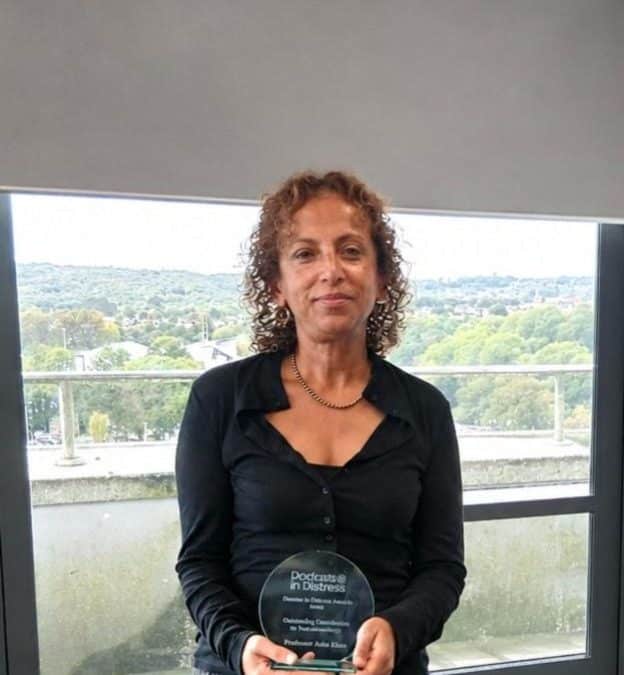
Doctors in Distress was delighted to present Professor Ann John OBE with our Outstanding Contribution to Systemic Change Award. Ann chaired the committee that developed BS 30480 Suicide and the workplace, the world’s first standard on suicide awareness at work, published by BSI in November 2025. We spoke to her about how the standard came together, and why it matters for healthcare.
Had you heard of BSI before this work, and what did you know of them?
Like most of the population, I had seen a BSI kitemark on things. In my mind they were about health and safety and widgets, so when they approached me I was intrigued about what they might possibly want to talk to me about, and probably still slightly sceptical.
Then they told me this wasn’t the first time they had developed a standard that wasn’t about gadgets. They talked about the menopause standard they had released the year before, and I realised that a lot of what I was seeing in the university and in the NHS had arisen because BSI had put out that standard. That convinced me of the power of working with them.
The standard is designed for 3.2 million workplaces. Were you daunted, and how did you get going?
BSI has a really clear structure for how it develops standards, so you come in as committee chair to a process they know well, and they have the relationships with those workplaces. We had between 60 and 70 organisations round the table. Even though everyone worked in fields where suicide and self-harm might be high risk, reaching consensus on content was no mean feat. Keeping the vision of what we were trying to achieve in front of everyone is what kept those conversations going, and helped us find compromises about language across different systems and how we talk about things.
Could you outline the stages the committee went through?
We had a drafting panel, a communications and engagement panel, and the overarching committee, working to a timeline with repeated consultations between the drafting panel and the committee. BSI then puts every standard out to public consultation, and as a drafting panel we went through every single comment, meticulously, over five days. Their methodology is built on reaching consensus, and that is what makes the result adaptable.
When you’re talking about suicide prevention, language is so important. The language you use can instil hope and help people feel heard, or it can make them feel stigmatised and belittled. When a colleague dies, or someone is in acute distress, people worry about saying the wrong thing or making the situation worse. The standard covers how to have a conversation and what language to use, and it addresses the myths. There is no evidence that asking someone puts the idea in their head.
But what is really different is that it says you need to embed this work in your existing policies and practices. You need a leader and a champion, people who are accountable, and clear pathways so people know who to speak to and what the limits of confidentiality are. Some workplaces are enormous, with HR departments and in-house counselling; some are three people in a small office. The standard needed to work for all of them, and the consultation process is what makes it adaptable to every workplace.
How long did it take from start to finish?
About a year.
The people involved were often volunteering their time. How did you get the best from such a diverse group?
Fundamentally, it isn’t a hard job, because most people who work in this field are utterly devoted to making a difference, to preventing suicide and ensuring people get the support they need when they need it, so you’re starting from a good place. With so many voices you can see how you might lose people, so the BSI process matters in making sure people feel heard and can see where their input has gone. But the main thing is keeping the vision of how the standard can make a difference in front of everyone. You could feel that devotion in the room when we launched at Speaker’s House, where many of us met in person for the first time.
What did you personally enjoy most about the project?
Two things. First, the people: the BSI team and everyone on the committee were amazing to work with. Even where we came at things from different perspectives, everything was talked out, with people genuinely trying to get to a solution. Being part of that collective commitment to create something that would really make a difference was very powerful.
Second, the opportunity it provides to make a difference. The standard has been downloaded 17,000 times in 168 countries, and there are things growing out of it, including a shorter “first steps” guide, because it is a hefty standard, with actions such as having a named lead, and work in other sectors, including with The Royal Foundation and Chasing the Stigma in the ‘On Your Side’ toolkit for the sports sector. In many ways the standard is just the beginning. The offshoots, like the work Doctors in Distress is doing in the NHS, are led by people in the sectors they know, and I find that amazing.
How important was support from parliamentarians and policymakers?
Absolutely vital. I can’t go without mentioning Liz Twist MP, who chairs the All-Party Parliamentary Group on suicide and self-harm prevention and was an absolute champion of the standard in raising its profile. The Minister for Mental Health also came and spoke at the launch. This is a topic almost everyone has been touched by in one way or another, and people putting their name to it in that way really makes a difference.
Doctors in Distress is coordinating NHS trusts and practices to implement the standard. Why is that valuable, and why do healthcare workers need it?
For lots of reasons. Because healthcare is seen as a caring profession, people assume these things are already in place, and often they are not, or not in the way you would want. Fitness to practise is also really important, not just for doctors but for all healthcare workers, so there can be fear and increased stigma around speaking up and getting the help you need. And because people are invested in helping others, there can be a sense of being invincible, until you’re not.
Healthcare is a major employment sector, so it is an important setting for this work in its own right, but it is also important for health to lead the way. It’s like putting on your own oxygen mask before helping others: a healthy, thriving workforce that has these policies and practices, understands the pathways, and addresses stigma, is a workforce that can do its job more effectively. As a doctor myself, I know the barriers to help-seeking get ingrained from a very young age. Organisations having a psychologically safe working environment, with these processes in place, is transformative and hugely important.
Finally, what is your message to policymakers about preventing suicide in the workplace?
Adopt the standard, and make sure organisations have an obligation to put these policies and processes in place for their staff. Across the four nations, we all have suicide and self-harm prevention strategies, so policymakers have made the commitment. What the BSI standard does is help put that policy into practice, and that matters for people’s day-to-day lives.
If you are affected by suicide or are struggling right now, help is available. Call Samaritans free on 116 123, or find crisis support.